Landing Page Leaks · 9 Conversion Signals
Fix 5 Hidden Conversion Leaks to Scale Your Landing Page
A non-converting landing page frequently exhibits observable friction across standard page signals. Changing button colour will not fix a broken promise. This article shows you how to identify candidate friction points before making redesign assumptions.
Direct answer: diagnose the sequence before changing the page
Start by separating acquisition from page behaviour. Check the page in this order: promise, proof, CTA, mobile layout, then objections. The first failed check is the next hypothesis to investigate, not a confirmed cause. Record the current page and traffic baseline before changing one variable.
- Can a cold visitor explain your offer in 5 seconds without reading past the headline?
- Does the page show specific, dated proof that people like the visitor have succeeded?
- Does the CTA name what happens next - not just "Submit" or "Get Started"?
- Does the page pass a one-thumb scroll test on a 390px screen without loss of message?
- Are the three main objections answered before the final CTA?
WordStream's 2026 Google Ads Benchmarks report - analysing over 13,000 search advertising campaigns from April 2025 to March 2026 - found an all-industries median conversion rate of 8.18%, ranging from 2.64% in Finance and Insurance to 16.22% in Animals and Pets. These are median figures across Google and Microsoft Ads search campaigns, not single-page rates. Use them only as context; they do not establish what an individual page should achieve.
Leak 1: The ad promise does not match the page headline
Symptom
Click-through rate on the ad is acceptable, but the page bounce rate is above 70% and time-on-page is under 10 seconds. Visitors are arriving and immediately leaving.
What it looks like
An ad running on “project management software for remote teams” lands on a page whose headline reads “The Future of Work, Powered by AI.” The visitor clicked because they want to manage a remote team. The headline tells them nothing about whether they are in the right place. Research by Lindgaard et al. published in Behaviour & Information Technology (doi:10.1080/01449290500330448) found that users form a visual impression of a webpage in approximately 50 milliseconds - before they have read a word. The headline is the first word they read. If it does not confirm the promise, the decision to leave is already forming.
Self-check
Copy your ad headline. Open your landing page. Does the page headline contain the same noun phrase - the same specific outcome or audience - as the ad? If you have to interpret or infer the connection, so does a cold visitor.
Fix
Rewrite the hero headline to echo the ad's specific promise. If the ad says “50% off running shoes for wide feet,” the page should say “Wide-Fit Running Shoes - 50% Off This Week.” Not a paraphrase - the same nouns. The visitor arrived because of a specific promise; the headline either confirms they are in the right place or it does not. Message-match is signal 1 of the 9 conversion signals the Nebula audit measures, because it shapes whether any of the other signals get a chance to work.
Leak 2: Proof is generic, anonymous, or absent
Symptom
Visitors scroll past the hero but abandon before the CTA. Heatmap data (if you have it) shows engagement drop-off around the testimonial or social-proof section.
What it looks like
“This product changed my business.” - J.T., Business Owner. That quote is indistinguishable from a placeholder. The visitor does not know if J.T. is real, if their business resembles theirs, or what specifically changed. Proof that cannot be verified does not reduce purchase risk - it increases it, because it signals that genuine evidence may not exist.
Self-check
Look at each testimonial or proof element on your page. Does it include: a full name (or clearly labelled composite), a specific outcome with a number or timeframe, and enough context for a similar visitor to recognise themselves? If not, it is not doing conversion work.
Fix
Replace generic quotes with specific ones. “We went from 1.2% to 4.1% conversion rate on our SaaS trial page in three weeks” is proof. “Game-changer” is decoration. If you do not have specific testimonials yet, use a before/after case note with enough detail to be falsifiable. One real proof point is more useful to a reader than five vague ones because it can be checked.
Leak 3: The CTA does not match where the visitor is in their decision
Symptom
The CTA button exists and is visible, but click rate is low relative to scroll depth. Visitors are reading the page and stopping at the CTA.
What it looks like
A page selling a high-consideration engagement leads with “Book Now” as the primary CTA, before any explanation of what the engagement involves, who it is for, or what the outcome is. “Book Now” is the right CTA for a visitor who has already decided - it is the wrong CTA for a visitor who has just arrived. Asking for full commitment before establishing value is the most common pattern in pages we audit.
Self-check
Read your CTA button text. Does it describe what the visitor gets, or what they have to do? “Book Now” describes what they do. “See How It Works” or “Get Your Diagnosis” describes what they get. For high-consideration purchases, a CTA that offers the next step in the decision process is a useful alternative to test against a final-commitment ask.
Fix
Match the CTA to the temperature of the traffic. Cold paid traffic landing on a page for the first time is not ready to “Buy.” Offer them the next decision step: a free audit, a demo, a specific deliverable. Reserve “Buy Now” or “Book Now” for pages where visitors have already consumed proof and understand the offer. Also check form friction: if the form asks for more fields than the next step requires, each extra field is a reason to stop.
Not sure which leak is active on your page?
Run the free Nebula audit. It checks all 9 conversion signals and tells you which one is breaking the sequence.
Run the free auditLeak 4: The mobile experience breaks the message
Symptom
Desktop conversion rate runs higher than mobile, despite mobile accounting for the majority of paid traffic clicks. The gap is not a device-preference issue - it is a layout problem.
What it looks like
On desktop, the hero section shows a headline, a subheadline, a proof point, and a CTA button - all above the fold. On mobile at 390px, the headline wraps to four lines, the subheadline disappears, and the CTA button is below the fold before the user has scrolled. The visitor sees a wall of text and a button they have to hunt for. The message sequence - promise, proof, action - is intact on desktop and broken on mobile.
Self-check
Open your landing page on a real phone (not a browser emulator). Without scrolling: do you see a clear headline, at least one proof signal, and a CTA button? If the button is not visible without scrolling, many visitors will not scroll far enough to find it.
Fix
Design the above-fold mobile layout as the primary canvas, not a scaled-down version of desktop. The headline should be under 10 words to avoid wrapping to four lines. The CTA must be a full-width tap target visible without scrolling. Social proof can move below fold on mobile - the headline and CTA cannot. Test on a real device, not a browser emulator; emulators do not replicate thumb reach, font rendering, or how the browser chrome eats viewport height.
Leak 5: Objections are not handled before the final ask
Symptom
Visitors scroll all the way to the bottom CTA and still do not convert. Scroll depth is high, time-on-page is reasonable, but the final conversion rate is low. The page has their attention - it has not resolved their hesitation.
What it looks like
A SaaS trial page shows features, pricing, and a sign-up CTA but does not address: how long setup takes, whether a credit card is required, what happens when the trial ends, or who to contact if something breaks. These are four questions a realistic buyer has before they enter their email. If the page does not answer them, the visitor leaves to find the answers - and often does not come back.
Self-check
List the three main reasons a qualified buyer would not convert on your page. Now check whether each reason is addressed - not in your FAQ, but on the page, above or adjacent to the final CTA. If the answers are buried or absent, the objection is a live conversion blocker.
Fix
Add a three-item objection block directly above your final CTA. Format it as specific answers, not marketing copy. “No credit card required” is an objection answer. “Risk-free trial” is marketing copy - it raises the question of what “risk-free” means and who defined it.
Which leak do you fix first?
The five leaks above are the failure modes a founder experiences; the 9 conversion signals are what the Nebula audit measures - each signal maps to the leak it surfaces. Fix in signal order. Earlier signals act as gates: if signal 1 is broken, fixing signal 6 does nothing.
Signal 1 - Message match
Test: Does the headline echo the ad promise exactly?
If no: Fix this first. Nothing else matters until visitors know they are in the right place.
Surfaces: Leak 1
Signal 2 - Trust signals
Test: Is there at least one specific, verifiable proof point above the fold?
If no: Add before optimising the CTA. The CTA can only convert visitors who believe the offer. Unresolved purchase objections are also a trust failure - this signal surfaces both Leak 2 and Leak 5.
Surfaces: Leaks 2 and 5
Signal 3 - Mobile viewport
Test: Is the primary CTA visible on a real phone without scrolling?
If no: Fix before running mobile traffic. Desktop conversion data does not transfer to a broken mobile experience.
Surfaces: Leak 4
Signal 4 - Load speed
Test: Does the page load in under 3 seconds on a mobile connection?
If no: Slow load time bleeds conversions before the page is seen. Not covered by the five-leak model above - covered in depth in Landing Page Load Time Slow.
Signal 5 - CTA clarity
Test: Does the CTA describe what the visitor gets, not what they have to do?
If no: Fix now. A mismatched CTA wastes all the attention the page built.
Surfaces: Leak 3
Signal 6 - Above-fold clarity
Test: Can a visitor identify the offer, who it is for, and what to do next within 5 seconds of landing?
If no: Restructure the hero. If the value proposition requires scrolling to understand, most paid visitors will never reach it.
Surfaces: Leak 1
Signal 7 - Ad tracking
Test: Do the page's conversion elements (form, CTA, offer framing) align with the campaign objective and audience segment?
If no: Misaligned ad-to-page signals waste spend by attracting clicks that the page cannot convert.
Signal 8 - SEO foundations
Test: Does the page have a unique title, meta description, and crawlable content that matches its paid intent?
If no: Not covered by the five-leak model above. Covered in depth in the full audit methodology.
Signal 9 - AI readiness
Test: Is the page structured so that AI answer engines can extract and cite its claims accurately?
If no: Not covered by the five-leak model above. AI citation readiness ensures the page remains discoverable as search shifts toward retrieval-augmented answers.
Frequently asked questions
What is the most common reason a landing page does not convert?
A broken promise between the ad and the page headline. When the ad says '50% off running shoes' and the page headline says 'Shop Our Collection,' the visitor has no confirmation they are in the right place and leaves. This is what the message-match signal in Nebula's 9-signal audit framework measures.
How do I know if my landing page conversion rate is actually low?
WordStream's 2026 Google Ads Benchmarks report - analysing over 13,000 search advertising campaigns from April 2025 to March 2026 - found an all-industries median conversion rate of 8.18%, ranging from 2.64% in Finance and Insurance to 16.22% in Animals and Pets. These are median figures across Google and Microsoft Ads search campaigns, not single-page rates, but they give a realistic floor for your vertical. If you are consistently below your vertical's lower bound with meaningful traffic (500+ sessions), that suggests evaluating structural page friction as a candidate cause.
Should I A/B test my landing page before diagnosing the problem?
No. A/B testing is a measurement tool, not a diagnostic tool. Testing two versions of a page with a broken promise doubles your spend on the wrong problem. Diagnose the leak first - identify which of the five patterns is active - then test the fix against the control.
What is message match and why does it matter?
Message match is the degree to which your landing page headline repeats or reinforces the specific promise in the ad that brought the visitor there. A visitor who clicked 'Free 30-day trial for SaaS teams' expects to see those words, or close equivalents, immediately on the page. When they do not, they assume they clicked the wrong link and leave. High message match reduces the first decision a visitor has to make: am I in the right place?
How long does it take to fix a non-converting landing page?
Depends on which leak is active. A message-match fix (rewriting the headline and hero copy) takes 2-4 hours with a clear brief. A proof restructure (repositioning testimonials, adding specificity) takes a day. A full CTA and form-friction overhaul is 1-2 days. Nebula's $97 One-Leak Repair Sprint supplies a tailored change for one high-confidence finding; you or your developer implements it, and the 30-day re-audit verifies the page condition.
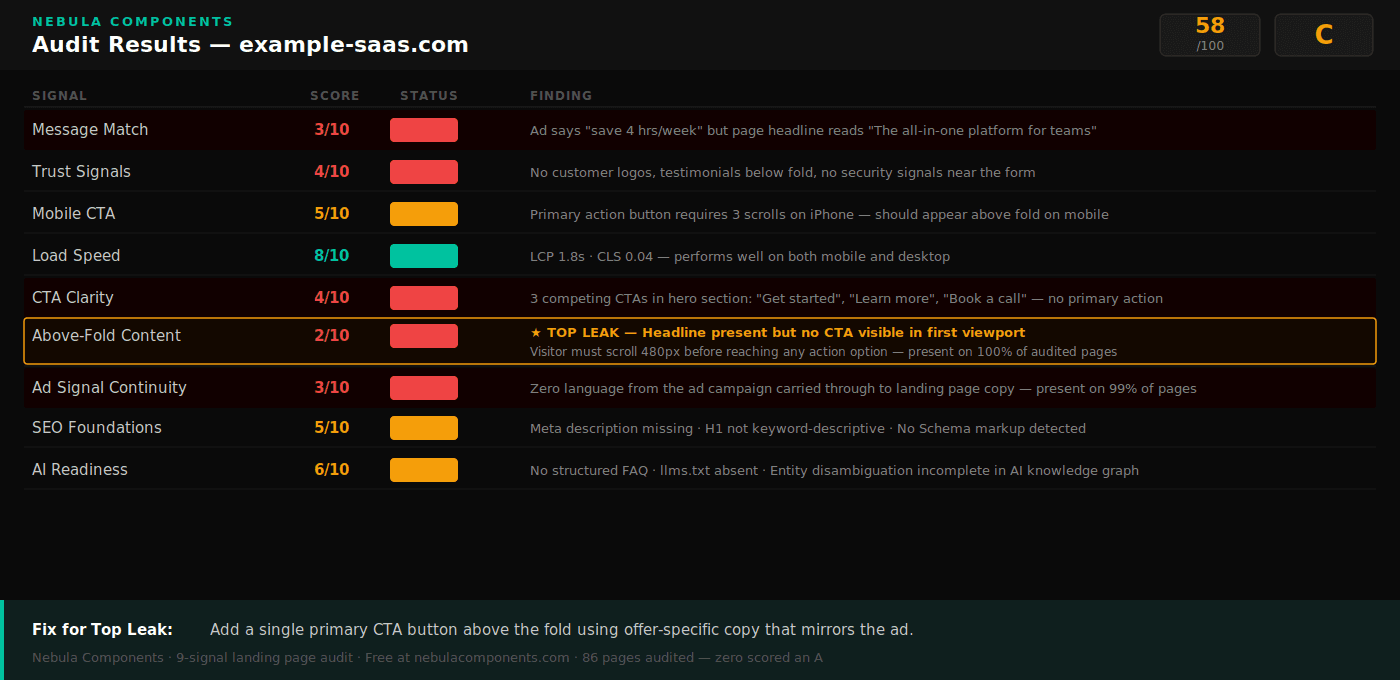
Not a mockup
This is a real audit, not an illustration
We ran nebulacomponents.com through the same audit engine every visitor uses. No edits, no cherry-picked run - this is the actual results screen.
Find the leak on your page
The free Nebula audit checks all 9 signals and returns a prioritised list of what to fix first. The $97 One-Leak Repair Sprint supplies a tailored change for one high-confidence page-level finding. You or your developer implements it, and the 30-day re-audit verifies the page condition. It does not promise conversion lift.