Public audit / not a customer
Miro Landing Page Teardown: What the Evidence Shows
The page names collaboration and shows several recognizable work modes, but a first-time visitor must connect those modes to the newer AI workspace framing before the primary action feels specific. miro.com This public snapshot was captured on September 17, 2026. Miro is not a Nebula customer.
Score
7.3/10
Grade
B
Findings
3
Audited
September 17, 2026
Same engine, public URL
Analysis snapshot
What this page appears designed to accomplish
Present Miro as a shared workspace for human collaboration and AI-supported work, then route visitors toward starting a board or exploring a specific use case.
What a first-time visitor can understand
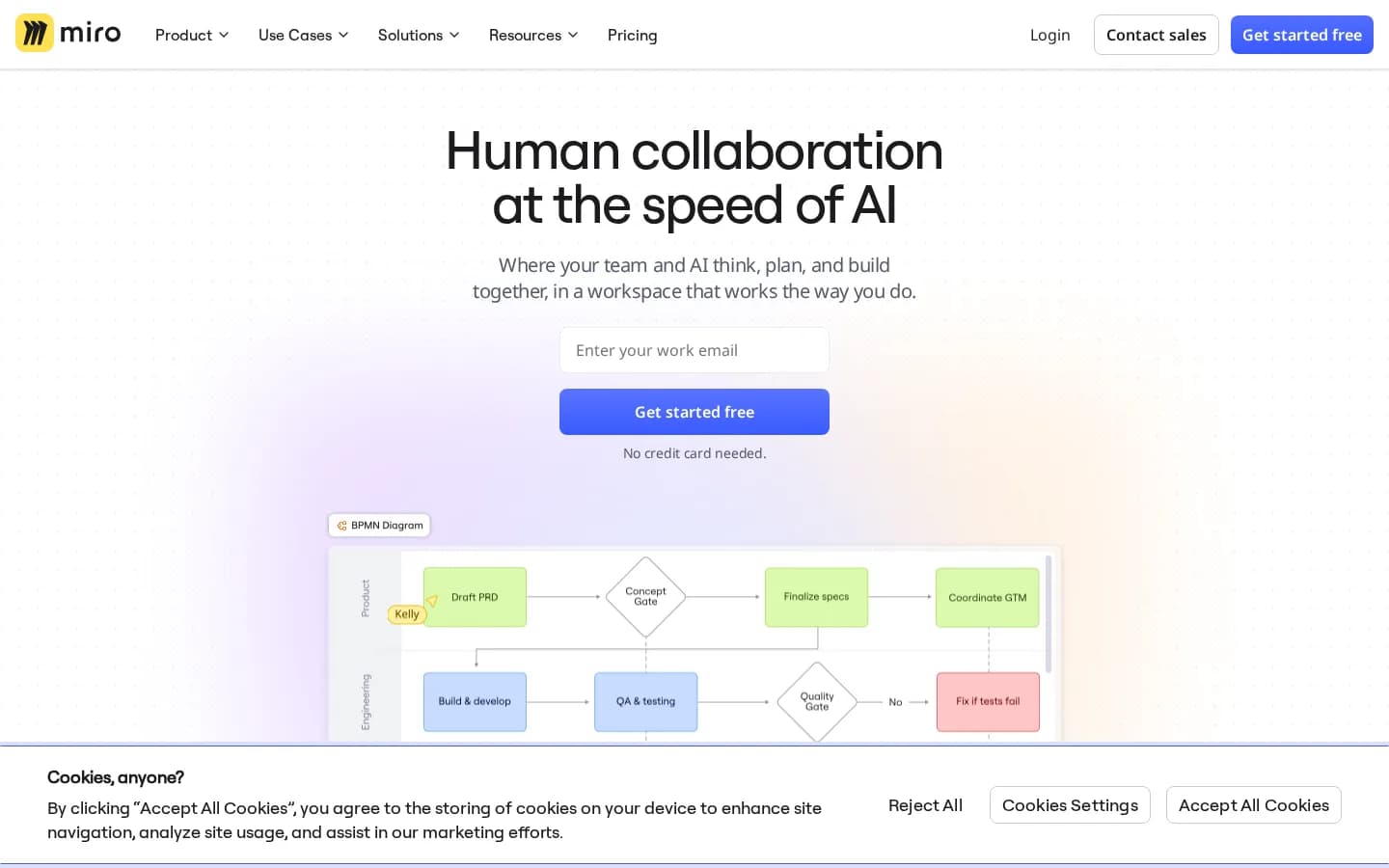
The page names collaboration and shows several recognizable work modes, but a first-time visitor must connect those modes to the newer AI workspace framing before the primary action feels specific.
What is working
- The page title establishes an AI workspace category.
- The H1 makes human collaboration the central theme and the page exposes concrete work modes such as research, roadmaps, diagrams, and workshops.
- The primary CTA and no-card-needed language provide a clear low-friction entry path.
Material findings
headline
Observation: The H1 is “Human collaboration at the speed of AI” and does not state a concrete action or product category keyword.
Evidence: Audit 82a3b9f1-9149-49c1-bcdc-c62880f36ab1: headline finding reported that the H1 lacks a verb or value-proposition keyword. Page title: “AI Innovation Workspace | Miro”.
Why it matters: A visitor can recognize collaboration as the theme, but still has to infer whether Miro is primarily a whiteboard, an AI workspace, or a broader planning tool.
Bounded remediation: Pair the current headline with a concise category-and-job statement in the first viewport, then verify that the title and H1 describe the same primary concept.
above_fold
Observation: The audit source proxy did not find the H1 in the first 2,000 characters.
Evidence: Audit 82a3b9f1-9149-49c1-bcdc-c62880f36ab1: above-fold finding reported H1 not in the first 2,000 characters. Browser captures were retained at 1440x900 and 390x844 for rendered comparison.
Why it matters: The initial document gives non-rendering consumers less immediate access to the page explanation, while the browser view must carry the first-screen comprehension burden.
Bounded remediation: Move the core category statement into the initial document and confirm the rendered first viewport still leads with one explanation and one primary action.
ai_readiness
Observation: The captured source did not contain JSON-LD or a complete heading hierarchy.
Evidence: Audit 82a3b9f1-9149-49c1-bcdc-c62880f36ab1: AI citation readiness finding reported missing JSON-LD and heading hierarchy.
Why it matters: The public document provides less machine-readable structure for identifying the page entity and its section relationships.
Bounded remediation: Validate the current visible hierarchy and add only schema supported by the rendered page and the site’s schema policy.
load_speed
Observation: The fetched HTML was approximately 931 KiB.
Evidence: Audit 82a3b9f1-9149-49c1-bcdc-c62880f36ab1: load-speed finding measured approximately 931 KiB of HTML.
Why it matters: A large initial document carries more parsing and transfer work before the page finishes explaining the product, especially on constrained devices.
Bounded remediation: Profile the rendered critical path and defer non-critical content without removing the work-mode examples that explain the product.
Unknowns and limitations
- Private conversion data, traffic mix, experiment history, and internal positioning decisions were unavailable.
- The public snapshot does not establish whether any observed condition caused conversion loss or changed product adoption.
- Public homepage snapshot captured September 17, 2026.
- Static audit evidence and rendered viewport evidence answer different questions and are not interchangeable.
- The analysis does not evaluate the Miro application, board collaboration quality, or customer outcomes.
Transferable lessons
- When a broad collaboration product adds an AI framing, the first viewport should connect the new category language to a familiar job before presenting multiple work modes.
- A work-mode grid can make a broad product concrete, but it should support one clear entry decision rather than replace the category explanation.
Methodology: Fresh static audit plus desktop and mobile browser captures. Findings are observable conditions with bounded recommendations, not outcome claims.
Captured 2026-09-17T23:46:08Z from https://miro.com. Analysis version 1.0.0; audit version 2.1.0.
Page snapshot · September 17, 2026
Three Findings
Ranked by observable priority. Each finding includes the evidence Nebula used - no opinion, no estimation. Priority scores are rule-based heuristics for fix order, not predicted conversion loss.
Finding 1
H1 Framed as Absence, Not Outcome
H1 reads "The collaboration layer your AI tools are missing.", the primary conversion message is that the visitor currently lacks something. This negative framing creates a deficit anchor before making a positive case. The H1 and title ("AI Innovation Workspace | Miro") share no keyword.
Evidence
H1: "The collaboration layer your AI tools are missing." Title: "AI Innovation Workspace | Miro". Zero keyword overlap between the two primary signals.
Recommended Fix
Reframe positively: "The AI workspace where your team and agents build together." Align the H1 keyword with the title's "AI workspace" framing.
Finding 2
H1 / Title Keyword Misalignment
The title uses "AI Innovation Workspace" as the primary keyword; the H1 uses "collaboration layer" with no workspace reference. Two different product descriptions on the same page.
Evidence
title: "AI Innovation Workspace | Miro". H1: "The collaboration layer your AI tools are missing." No shared primary keyword.
Recommended Fix
Align the H1 on the title's keyword. If "AI workspace" is the SEO target, the H1 should contain "workspace" or "AI workspace".
Finding 3
Above-Fold Source Proxy
The page is served via Framer, the above-fold content hierarchy is client-rendered. Non-JS crawlers see a reduced document.
Evidence
Page served via Framer CDN. Static source does not contain above-fold CTA in the first 3,000 characters.
Recommended Fix
Verify server-rendering of H1 and primary CTA in the Framer export settings. Miro's current "Get started free" CTA should appear in the initial HTML.
What This Demonstrates
Miro is a widely-used visual collaboration platform. The engine scores the page 7.3/B: clear CTA, "No credit card needed" friction removal, a comprehensive feature structure below fold. The headline finding is strategic: "The collaboration layer your AI tools are missing." is technically correct, Miro is pitching itself as the connective tissue for AI workflows, but framing the pitch around what is "missing" anchors the visitor to absence rather than outcome. The meta title is "AI Innovation Workspace | Miro" which shares no keyword with the H1.
Work at Miro? Verify ownership to manage this teardown in your workspace.
Claim this teardownSee what it finds on your page
Same engine, your URL. Free, no signup. Results in under two minutes.
Find the Leak →Already know your page has issues? Skip the audit.
Fix one leak now, $97 →One finding. 48h delivery. No call, no retainer.